

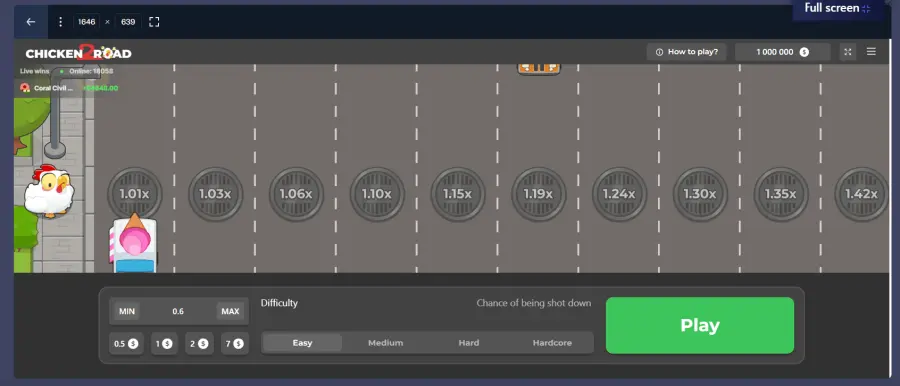




Chicken Road casino game RTP, odds, and low-stakes strategy guide
As of September 2025 in Tanzania, players keep asking whether chicken road is a fair, learnable crash-style title or just another streaky thrill ride that eats small balances. You’ll find a straight answer here based on basic probability, session math, and common-sense bankroll rules that hold up under short runs and longer trials. We’ll unpack return-to-player, variance, and cashout timing in ways that make sense to casuals who just want a few fun spins and to grinders who log a dozen short sessions a week. The focus stays on transparent expectations, practical safety steps, and the micro-stakes patterns most people actually play, without hype or miracle promises.
Advertised 98% RTP in Chicken Road explained with math
The headline claim you’ll see everywhere is a 98% RTP, and that figure can be workable if a venue implements the same curve, seed logic, and edge distribution used in testing chicken road game builds. In plain language, 98% RTP means that over enormous sample sizes the engine returns ninety-eight percent of total stakes to players, while the remaining two percent is the built-in house edge across all outcomes in chicken road. Because individual sessions are tiny compared to those sample sizes, your results will wobble around that long-run average, sometimes pleasantly and sometimes not. Treat RTP like climate, not weather: it guides expectations, but it doesn’t predict your next few minutes.
How RTP translates to realistic session-level expected returns
If you place many equal stakes and always cash out at the same multiplier, your expected change per round is stake × (cashout multiplier − house edge impact), which becomes visible after dozens of attempts in chicken road. With a 98% long-run figure, the expected drag per unit stake is roughly 0.02 of that stake, but your realized path depends heavily on when you tap out in chicken road game. Short cashouts “clip” variance but also cap gains; long chases swing harder and can miss by a fraction of a second. That is why disciplined stop-loss rules plus pre-defined target ladders are more important than any mystical “hot streak” story.
Chicken road game multipliers and probability mass overview
Crash-style multipliers cluster most of their probability mass at the low to mid range with a long tail that attracts risk-takers in chicken road game. Think of the distribution as a steep hill near 1.2×–2.0× and a slowly fading horizon where the occasional huge multiplier lives, along with long dry spells that can stress confidence in chicken road slot. On practical timelines—say 10–40 rounds—the early band dominates realized results, so automating exits in that band helps smoothen swings. Even then, variance will show up; your job is to choose how much of it you invite.
| Mode | Stage checkpoint | Multiplier band | Suggested auto-cashout range | Volatility note | Advertised RTP |
|---|---|---|---|---|---|
| Easy | Stage 1 | 1.20×–1.40× | 1.25×–1.35× | Low early busts | 98% |
| Easy | Stage 2 | 1.40×–1.80× | 1.45×–1.60× | Mild swings | 98% |
| Easy | Stage 3 | 1.80×–2.50× | 1.90×–2.20× | Moderate spikes | 98% |
| Medium | Stage 1 | 1.30×–1.70× | 1.35×–1.55× | Higher churn | 98% |
| Medium | Stage 2 | 1.70×–2.40× | 1.80×–2.10× | Noticeable whips | 98% |
| Medium | Stage 3 | 2.40×–3.50× | 2.50×–3.00× | Swingy tails | 98% |
| Hard | Stage 1 | 1.50×–2.20× | 1.60×–1.90× | Sharp dips | 98% |
| Hard | Stage 2 | 2.20×–4.00× | 2.40×–3.20× | Big variance | 98% |
| Hard | Stage 3 | 4.00×–6.50× | 4.20×–5.50× | Tail hunting | 98% |
| Hardcore | Stage 1 | 1.80×–2.60× | 1.90×–2.30× | Precarious | 98% |
| Hardcore | Stage 2 | 2.60×–5.00× | 2.80×–3.60× | Wild swings | 98% |
| Hardcore | Deep | 5.00×–10.0×+ | 5.50×–8.00× | Rare but huge | 98% |
Volatility and multiplier curves in the chicken road game
Variance in crash titles isn’t a flaw; it’s the mechanism that makes small wins common and big wins rare in chicken road. The curve for early multipliers tends to be dense, which is why consistent low targets can smooth bankroll lines, while higher targets thin out quickly and create gaps that feel like droughts in chicken road casino. When players chase the long tail without a plan, drawdowns feel personal even though they are just math doing its job. To keep emotions in check, pre-commit to a mode, a cashout ladder, and a maximum number of failed attempts per ladder step.

Variance tradeoffs when chasing hardcore stage multipliers safely
Hardcore steps can look irresistible because the displayed targets are clean numbers, but each attempt exposes you to more bust points than a quick exit in chicken road. A safer approach is to treat hardcore as an occasional “ticket” funded by prior small wins, rather than a default stance in every round of chicken road game. That way, a rare deep hit becomes gravy instead of a bailout plan for earlier over-risking. If you can’t articulate the bankroll fraction you’re risking on those tickets, you’re risking too much.
Safer routes for incremental cashouts in early stages
Early exits build a rhythm: hit, small gain, reset—repeat until the run stalls in chicken road casino. You can stack two nearby targets, such as 1.30× and 1.55×, and rotate between them to reduce predictability while still staying inside the fat part of chicken road game’s curve. The aim isn’t to “outsmart” the engine; it’s to keep session volatility inside your emotional comfort zone. If you ever catch yourself increasing targets out of boredom, step away.
How player behavior shapes outcomes in chicken road casino
Mechanics decide the outcome, but behavior decides whether you experience those outcomes as controlled steps or chaotic swings in chicken road game. People tilt when they change plans mid-session, especially after near-misses that feel unfair in chicken road. A reliable routine is simple: fixed ladder, fixed number of attempts per step, fixed cool-down after a drawdown. The more your routine is written down, the less space there is for on-the-fly guesses.
Manual versus auto cashout under varying risk preferences
Auto-cashout is discipline on rails: you set a number and honor it even when a round looks like it might run higher in chicken road. Manual cashouts give flexibility for exceptional runs, but they also invite second-guessing in chicken road game. Many low-stakes players do best with auto for the first target of a ladder and manual for any “bonus” push that uses prior profits only. If your manual overrides keep happening in losing stretches, go back to auto for a while.
Session length, tilt control, and stop-loss discipline habits
Short sessions cap exposure to streaks you can’t emotionally sit through in chicken road game. A common pattern is three mini-sets of ten rounds each with a small break in between—long enough to feel meaningful, short enough to reset if needed in chicken road casino. Write your stop-loss in units, not feelings, and respect it even if the very next round “would have” saved the day. Future you will thank current you for walking away clean.
Low entry stakes: playing chicken road online game with TZS
Micro-stakes are the most forgiving way to learn timing and build habits in chicken road online game. Tanzania-friendly platforms typically allow very small unit bets, which lets you rehearse ladders without risking the week’s entertainment budget in chicken road. Keep the unit small enough that ten losses in a row feel like a lesson, not a crisis. Once your ladder feels automatic, scale the unit modestly and reassess after a set number of sessions.
Typical minimum bets and payouts converted to Tanzanian Shilling
Minimums vary, but micro-stakes commonly start low enough to test two-step ladders with minimal stress in chicken road. All examples below are shown in Tanzanian Shilling and aim to illustrate how small targets accumulate returns in chicken road game online. Gross payout is simply bet × multiplier, while net profit subtracts the original stake. Treat these samples as templates you can rewrite to your own comfort level.
| Bet (Tanzanian Shilling) | Stage reached | Example multiplier | Gross payout (Tanzanian Shilling) | Net profit (Tanzanian Shilling) | Notes |
|---|---|---|---|---|---|
| 1,000 | Early | 1.30× | 1,300 | 300 | Quick clip |
| 1,000 | Early | 1.60× | 1,600 | 600 | Slightly spikier |
| 2,000 | Mid | 2.00× | 4,000 | 2,000 | Ladder step |
| 2,000 | Mid | 2.50× | 5,000 | 3,000 | Bonus push |
| 3,000 | Mid | 3.00× | 9,000 | 6,000 | Rare attempt |
| 5,000 | Early | 1.35× | 6,750 | 1,750 | Safer clip |
| 5,000 | Mid | 2.20× | 11,000 | 6,000 | Target two |
| 10,000 | Early | 1.25× | 12,500 | 2,500 | Entry test |
| 10,000 | Mid | 2.80× | 28,000 | 18,000 | Opportunistic |
| 20,000 | Deep | 4.00× | 80,000 | 60,000 | Ticket only |
| 20,000 | Deep | 6.00× | 120,000 | 100,000 | Very rare |
| 30,000 | Early | 1.40× | 42,000 | 12,000 | Still tame |
Editorial reminder: if any venue shows examples in foreign currencies, update conversions to Tanzanian Shilling at review time.
Bankroll segmentation for micro-stakes chicken road sessions today
Split your weekly entertainment pot into small session “slices” that limit damage when timing goes off in chicken road. A common rule is to bring only one slice to the table and leave the rest parked until the next scheduled session in chicken road casino. Within a session, pre-label a tiny share as your “bonus push” budget so you can test one mid-range multiplier without touching the core pot. If you run hot early, consider ending the session rather than rewriting your ladder on the fly.
Game modes and risk ladders in chicken road game casino

Modes gate volatility: Easy favors quick exits, Medium adds churn, Hard and Hardcore invite tail-chasing in chicken road game casino. Choose a mode that matches your mood and time budget before you stake, because switching mid-session invites rationalizations in chicken road game. If you want occasional higher targets, schedule them instead of reacting to a flashy round. That tiny bit of structure saves nerves and currency.
Easy, medium, hard, and hardcore mode differences explained
Easy mode rewards discipline with frequent small exits and fewer gut-punch busts in chicken road casino. Medium mode expands the workable ladder but punishes hesitation, so preset numbers matter more. Hard mode is where many players overestimate their tolerance for drawdowns; if you sense that edge, scale back for a while. Hardcore mode should be treated as a funded experiment, not a lifestyle.
Choosing game difficulty to match target ROI goals
Map ROI goals to volatility realistically in chicken road game. If your aim is steady micro-growth, prioritize Easy or low Medium with modest multipliers and quick resets. If you’re bankroll-healthy and emotionally fresh, schedule a few Hard tickets that use profits only. Matching difficulty to goals keeps the plan coherent when randomness gets loud.
Provider facts: who built chicken road and who licenses it
Studios and platform companies sometimes appear under different legal names, so you’ll often see a production label credited to a studio while operations sit with a corporate entity; that’s normal in regulated gaming and affects how chickenroad gets listed by venues. Many crash-style titles operate under offshore e-gaming frameworks, and claims of independent audits should be stated in clear, public terms. Players should look for visible responsible-gaming tools, clear KYC/AML policies, and unambiguous contact channels before staking. If a venue lists sequel content or engine upgrades, verify that the original math profile carries over rather than assuming it does as with references to chicken road 2.
InOut Games background and IOGr B.V. registration notes
Studios typically present a trade name for branding and a registered company for compliance, with corporate registries holding the hard details. When evaluating any studio label, check for registration jurisdiction, legal representative, and the scope of the license claim. Public statements about audits or RNG oversight should be specific enough to be meaningful, not just buzzwords. If the facts you need aren’t plainly posted, treat that opacity as a signal to slow down.
Regions, partner regulators, and availability caveats for players
Regional availability depends on the venue’s license portfolio and its risk policy toward gray-area traffic. Serious platforms publish restricted-country lists, outline VPN policies, and state which dispute resolution avenues apply. Tanzania-friendly sites should also surface localized payment options and responsible-gaming contacts that actually respond. If any of those pieces are missing or vague, consider trying a different venue.
| Entity | License/claim (publicly stated) | Responsible-gaming tools | RNG/Audit status (if stated) | Access notes | Support channels |
|---|---|---|---|---|---|
| Studio label | e-gaming claim | Limits, cool-offs | Third-party test noted | Regional restrictions listed | Email/Chat |
| Partner A | Curacao-style claim | Limits, self-exclusion | Audit note present | Some countries blocked | Chat |
| Partner B | Multi-license claim | Limits, time-outs | RNG cited | Payment KYC strict | |
| Partner C | Single license claim | Loss limits | Testing not detailed | Cautious on VPNs | Chat/FAQ |
| Partner D | Regional permit | Cool-offs | Audit periodic | TZ deposits noted | Email/Phone |
| Partner E | Curacao-style claim | Reality checks | RNG noted | Fast KYC | Chat/Email |
| Partner F | MGA/UKGC partner | Full toolkit | Strong audit language | Wider restrictions | Ticket/Chat |
| Partner G | Local partner | Limits, budget tools | Stated oversight | Mobile focus | |
| Partner H | Curacao-style claim | Self-exclusion | Testing vague | Manual reviews | Chat |
| Partner I | Multi-license claim | Time caps | RNG named | Bonus limits strict | Email/Chat |
Odds by stage: safe cashouts versus chasing high multipliers
At low targets the probability mass is friendly, so frequent small exits can stack into a tidy line, whereas high targets thin the odds and introduce lumpy sequences in chicken road game. The trick is deciding when to pivot from clip mode to a measured “bonus push,” which is easier to do when the session starts with a few wins in chicken road. You don’t need perfect timing; you need rules you actually follow. That’s what turns variance from a foe into background noise.
When early exits beat riskier long runs mathematically
Because the house edge is fixed while your cashout point is flexible, your realized variance is the main lever you can pull in chicken road game. Early exits compound gently and keep emotions quiet, which preserves decision quality across dozens of attempts in chicken road. Long chases can pay beautifully, but only if they are pre-funded by earlier clips, not fueled by frustration. Let math lead; let mood follow.
Five staged cashout heuristics to test this week
- Two-step ladder: 1.30× then 1.55× when the first clip lands clean.
- “Profit-only push”: any attempt above 2.20× must use prior profit only.
- Three-strikes rule: after three busts at the same target, step down one notch.
- Cool-down timer: pause two minutes after any deep bust before the next stake.
- Weekly cap: pre-write the number of “bonus push” tickets before the week starts.
Try these for a fixed block of sessions, hold notes, and then adjust your targets—not the other way around. The aim is to test rules in calm conditions so you can trust them when randomness misbehaves.
Benchmarking target multipliers for chicken road game players
Benchmarks are reference points, not promises, and they help you see if your ladder is too timid or too wild in chicken road game. If your clips never reach 1.50×, you may be leaving growth on the table; if your “bonus pushes” mostly sit above 3.50×, you may be overreaching in chicken road. Keep a lightweight log for a week and compare the feel of play against those markers. Small tweaks beat dramatic swings.
Bankroll management tailored to chicken road slot sessions
Your bankroll plan should be boring, repeatable, and sized to your real-life budget in chicken road slot. Many players do well with a fixed session slice plus a tiny reserve that can fund one mid-range attempt in chicken road game. If you find yourself raising stakes to “get back,” that’s your cue to stop and review the plan. A calm plan saves both currency and nerves.
Flat wagering versus proportional staking in volatile games
Flat wagering uses the same unit each round, which keeps swings predictable and is well suited to short, clip-focused sessions. Proportional staking scales the unit to session balance, which can grow returns when things go right but can also amplify dips. For micro-stakes learners, flat first and proportional later is a sensible path. Revisit the choice monthly rather than mid-session.
Setting win goals and drawdown limits before starting

Write a small win goal and a strict drawdown limit before you open the game; then honor both. If you hit the win goal early, consider banking the feeling and keeping the rest of the day free. If you hit the drawdown, step away without negotiating with yourself. Discipline now buys confidence later.
Bankroll segmentation templates for 1%, 2.5%, 5% risk profiles
- 1% model: ultra-conservative unit, clip targets only, “bonus push” allowed once per full three-set cycle.
- 2.5% model: modest unit, two-step ladder, one mid-range attempt funded by prior profit each set.
- 5% model: experienced players only, scheduled Hard tickets, cool-down enforced after any deep bust.
These are starting shapes; personalize them to your budget and time. The right model is the one you can follow on a bad day.
Mobile play, speed, and chicken road login security basics
On mobile, split-second timing matters, so stable data and a responsive device are part of your edge in chicken road login. Keep background apps light to reduce latency and avoid switching networks mid-session in chicken road. If the app offers low-graphics mode, enable it for smoother cashout taps. Always assume you’ll be interrupted and size targets accordingly.
Latency, disconnects, and how they affect cashout timing
Even small delays can cause missed exits, so favor wired or stable Wi-Fi when you can. If you must play on cellular, test a few tiny stakes first to feel timing before committing. When a disconnect happens, don’t chase the “what if” round—reset and breathe. A cool head beats a perfect connection.
Account hygiene, two-factor authentication, and device safety basics
Enable two-factor authentication, avoid recycled passwords, and log out on shared devices. Keep your OS updated and use native app stores wherever possible. If you receive security prompts you didn’t request, change credentials immediately. Security hygiene is boring—and that’s the point.
Where to play: choosing a safe chicken road casino site
A good venue publishes who licenses it, how disputes get handled, and how fast payouts typically move in chicken road casino. You’re looking for clarity more than marketing, plus sensible rules around bonuses that won’t trap you in fine print in chicken road. If answers aren’t easy to find, treat that as a signal. You have options; pick the transparent one.
Licensing checks, dispute mediators, and payout histories review
Scroll to the legal footer for license numbers, named regulators, and any third-party testing mentions. Look for dispute mediation options and a track record of on-time payouts. If you can’t validate those basics in a few minutes, try a different venue. Clear beats flashy.
Seven verification steps before you join a site
- Find the exact license number and jurisdiction in the legal footer.
- Confirm responsible-gaming tools (limits, cool-offs, self-exclusion).
- Check KYC requirements and expected payout timeframes.
- Read wagering rules on bonuses, not just the headline offer.
- Verify customer-service channels and response windows.
- Scan restricted-country and VPN policies.
- Start with a tiny deposit and a tiny withdrawal to test flows.
Use this checklist once per venue and save your notes. A half hour of diligence can spare weeks of frustration.
Red flags for bonus traps and unrealistic promotion terms
Beware of vague wagering multipliers, time windows that don’t fit normal play, and exclusions that quietly block your favorite modes in chicken road. If a rule is unclear in chat, assume it won’t favor you in chicken road casino. Promotions should feel like a small boost to a plan you already like—not the plan itself. When in doubt, pass.
Bonuses and wagering on chicken road game without pitfalls
Bonuses can smooth variance if the rules are clear, but they’re not a shortcut to beating math in chicken road game online. Read the wagering multipliers and game-weighting lines slowly, then decide if the extra steps fit your routine in chicken road casino. If the rules push you toward risk you wouldn’t otherwise take, skip them. Your bankroll will thank you.
Welcome offers, reloads, and cashback impact on RTP
Welcome packages and reloads can lower effective cost per round if you were going to play anyway. Cashback softens drawdowns but rarely turns a losing ladder into a winning one. Track these effects weekly rather than round by round. The numbers look clearer on a calm Sunday.
Allowed betting strategies during wagering to stay compliant
Many venues cap maximum stake per round and restrict extremely low-risk patterns during wagering. If a rule conflicts with your safety plan, you don’t need that bonus. Keep a simple note of allowed stakes and exit points so you don’t slip during a long session. Compliance is part of control.
Common bonus types and typical wagering multipliers
- Welcome match: commonly paired with moderate wagering on slots/crash modes.
- Reload credit: smaller match, sometimes gentler conditions on off-peak days.
- Cashback: post-loss return with low or no wagering but narrow time windows.
Use bonuses to smooth—not to stretch—your plan. If terms feel pushy, your plan comes first.
Tanzania specifics: payments, currency, and practical limits today
Tanzania-oriented venues should clearly support local deposit rails, transparent limits, and straightforward verification that fits the market in chicken road casino. Keep deposits modest while you test processing times and reversal policies in chicken road. When in doubt, keep your unit small and your expectations clear. Clarity beats speed every time.
Deposit and withdrawal methods typically available to TZS players
Look for mobile-money compatibility, card support, and a bank payout option that posts within the timeframe the venue publicly states. Small test withdrawals help you validate the flow before you scale stakes. If a method repeatedly lags, switch rather than tolerate uncertainty. Convenience without reliability isn’t an upgrade.
Responsible gambling tools and local compliance considerations today
You should see deposit limits, loss limits, and time reminders that you can set and change deliberately. A venue that treats those tools as first-class features is usually a better long-term fit. Also expect standard KYC; prepare a clear photo ID and a recent proof of address. Being ready makes the process boring—in a good way.
INFO BOX — Keep examples denominated in Tanzanian Shilling. Use local payment names players actually see in checkout, and avoid quoting foreign currencies unless you immediately provide clear figures in Tanzanian Shilling.
Fairness checks, audits, and house edge transparency standards
Fair venues display the license they operate under and, ideally, the testing body that reviewed their engine in chicken road game. You’re looking for specificity: named lab, stated scope, and dates rather than generic claims in chicken road casino. If the venue references “provably fair,” it should point to a concrete method you can follow without special tools. Vague claims deserve cautious stakes.
Provably fair concepts and third-party testing expectations today
Provably fair usually means the game publishes seeds and hashing approaches that let players verify that outcomes weren’t altered after the fact. Third-party audits add confidence by checking implementation details and edge accounting. Neither replaces bankroll discipline or good session hygiene. They simply make the sandbox safer to play in.
Understanding Hardcore multipliers and maximum payout claims responsibly
Max payout banners are exciting, but the path to them runs through a very thin slice of the probability curve. Treat those claims as marketing caps, not everyday targets. If you pursue them, schedule attempts sparsely and fund them with prior profits only. That way, rare wins feel like wins—not rescues.
- Pre-planned auto-cashout targets shrink decision fatigue and keep bankroll drift contained over dozens of micro-stakes rounds, especially when the first target sits in the low-volatility band.
- Fixed stop-loss per session protects the week’s budget and maintains confidence when chicken road runs cold just as chicken road game shows an enticing multiplier.
- Using only prior-profit for “bonus pushes” lets you explore higher targets without threatening your core balance or your mood for the day.
- Volatility spikes will still arrive, and they can cluster in ways that feel unfair even when you follow the plan to the letter.
- Manual overrides during losing streaks can worsen tilt, turning a small scheduled drawdown into an outsized session loss.
- Over-reliance on tiny exits can stall overall growth if you never schedule occasional, measured attempts at mid-range targets.